
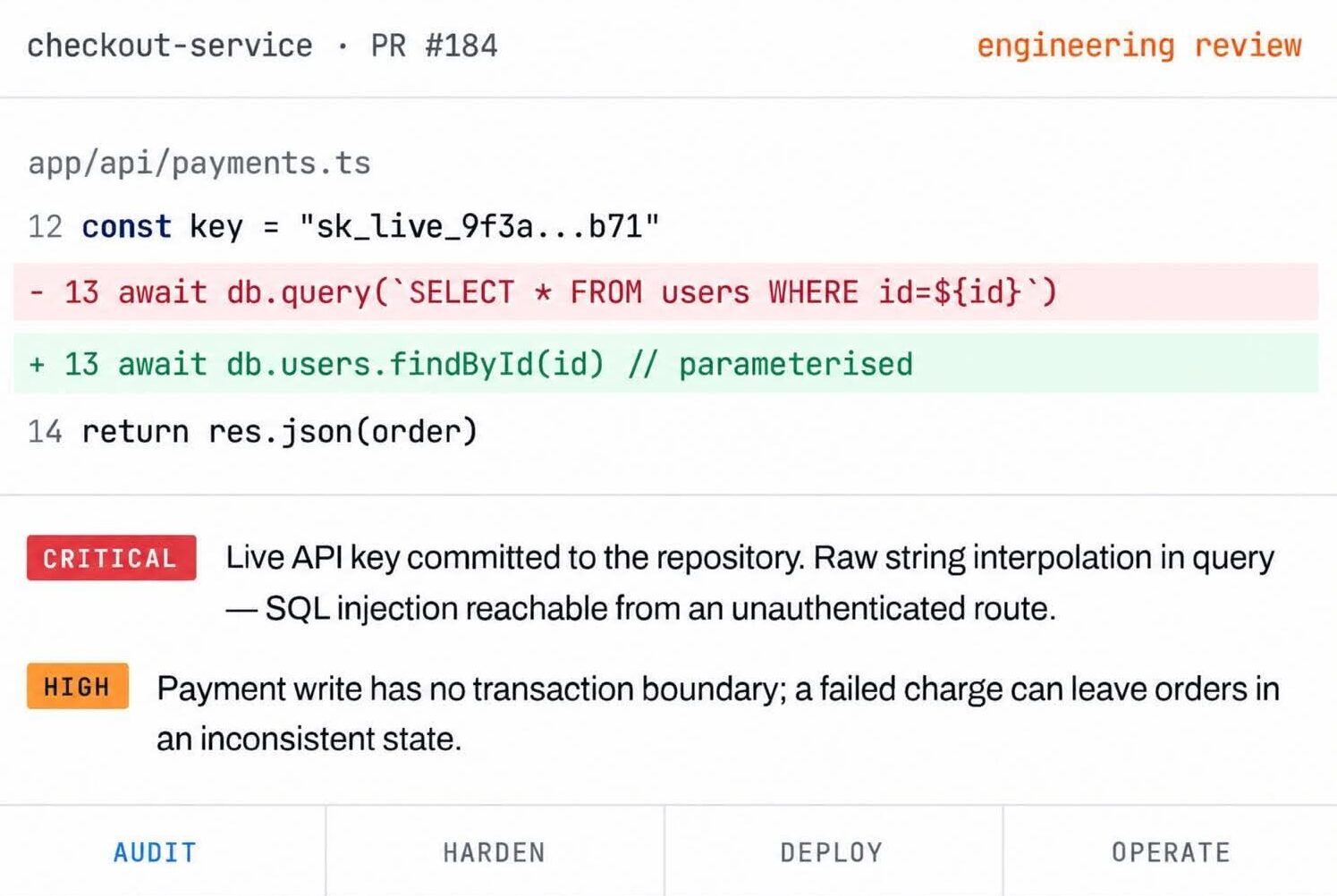
Modern AI coding tools generate impressive amounts of working code in hours. They also introduce issues that are genuinely difficult to spot without an engineering background — because the application still runs.
The gap isn’t between AI and humans. It’s between it works on my machine and it survives real users, real data and real attackers.
| Security vulnerabilities | Authentication & authorization mistakes | Hard-coded credentials and secrets | Poor database design |
| Missing transaction handling | Incorrect business logic | Duplicated or unnecessary code | Weak application architecture |
| Performance bottlenecks | Scaling problems | Insufficient validation | Missing error handling |
| Dependency vulnerabilities | Poor API security | Poor API security | Deployment weaknesses |
| Improper production configuration | No monitoring or alerting | No backup or disaster recovery | Single server, no scalability path |
| Inconsistent coding standards | Works today, unmaintainable tomorrow | Invisible, compounding technical debt | + the ones only visible in production |
|---|
Unexpected inputs
Infrastructure failures
External API
Deployments
Backups
Real customers
Concurrent users
Large datasets
Traffic spikes
Upgrades
Recovery
Real money
Security attacks
Failed transactions
Server failures
Monitoring
Future developers
Start with a single pull request or hand over the whole journey from AI-built prototype to professionally operated platform.
Application architecture
Security vulnerabilities
Database architecture
Dependency management
Scalability
Deployment configuration
Error handling & logging
Maintainability
AI code patterns
Backup & recovery
Architecture
APIs
Payment systems
Cloud infrastructure
Legacy modernisation
Backend
Database engineering
Authentication
CI/CD
AI-assisted workflows
Frontend
Integrations
Performance
Refactoring
Production deployment
Security
Performance
Testing
Architecture
Standards
Regressions
You shouldn’t have to become a DevOps engineer just because AI helped you build an application.
Cloud architecture
AWS & Azure
Linux server configuration
Managed databases
Docker & containers
Load balancing
CDN, DNS, SSL
Firewalls & app security
Redis & caching
Queues & workers
Real-time services
Object storage
The findings that most often turn a working prototype into a liability.
Whether the shape of the system can carry the product it is becoming.
Where AI-generated applications quietly accumulate the most risk.
Correctness and resilience of the code that holds your business rules.
Client-side behaviour, state and the trust boundary with your API.
Contracts, permissions and everything that can be called from outside.
The environment the application actually depends on to stay up.
Whether the production environment is fit for a business system.
What gets slow first, and how much headroom there really is.
Where the system breaks when usage multiplies.
Whether anyone can change this code safely — including AI.
How code gets from a prompt to production, repeatably.
The third-party surface AI tools tend to expand generously.
Whether you would know if it broke at 3am.
The cost of every future change, measured today.
| Horizontal scaling | Vertical scaling | Statelessness |
| Load balancing | Database scaling | Indexing |
| Read replicas | Caching strategies | Redis |
| Queues & async work | Worker architecture | Background jobs |
| API performance | CDNs | Object storage |
| File architecture | Real-time comms | Rate limiting |
| Multi-tenancy | Partitioning | High availability |
| Failure recovery | Cloud cost optimisation | Capacity planning |
We can review one pull request — or take responsibility for the entire journey from AI-built prototype to professionally operated software.
|
01
Idea |
02
AI prototype |
03
Engineering audit |
04
Refactor & harden |
05
Security review |
06
Professional infrastructure |
07
Production deployment |
|
08
Monitoring |
09
Scaling |
10
Ongoing support |
|
01
Idea |
02
AI prototype |
03
Engineering audit |
04
Refactor & harden |
|
05
Security review |
06
Professional infrastructure |
07
Production deployment |
08
Monitoring |
|
09
Scaling |
10
Ongoing support |
|
01
Idea |
02
AI prototype |
|
03
Engineering audit |
04
Refactor & harden |
|
05
Security review |
06
Professional infrastructure |
|
07
Production deployment |
08
Monitoring |
|
09
Scaling |
10
Ongoing support |
Prompt-driven development is a genuinely brilliant way to prototype, validate an idea and move at speed. It’s how a lot of good software now begins — including ours. The difference is what happens after it works.
01 · Prompt
02 · Generate
03 · Run
04 · Looks good
05 · Deploy
01 · Requirements
02 · Architecture
03 · AI-assisted development
04 · Code review
05 · Security validation
06 · Testing
07 · Infrastructure design
08 · CI/CD
09 · Deployment
10 · Monitoring
11 · Backups
12 · Scaling
13 · Support
| Infrastructure monitoring | Application monitoring | Server maintenance |
| Database maintenance | Security updates | Dependency upgrades |
| Backups | Incident investigation | Bug fixing |
| Performance improvements | Capacity planning | Deployment support |
| Release management | Infrastructure changes | Technical consultancy |
| Emergency support | Ongoing development |
We help organisations define how AI coding tools are used: what engineers may generate, what must be reviewed by a human, what can reach production, and how any of it is verified.
Delivered as an advisory engagement, scoped to your team and stack.
Repository structure
Code ownership
Dependency policies
Security scanning
Backup requirements
Founder / Entrepreneur
“I built my MVP with AI and want to launch it commercially.”
Startup
“We moved quickly with AI and now need to make sure the platform can scale.”
Established business
“Someone built us an application using AI and we want an independent technical assessment.”
Software team
“Our developers use Cursor, Claude and Copilot extensively and we want stronger engineering controls.”
Business without an IT team
“We built something useful with AI, but we don't want to manage servers, deployments and infrastructure ourselves.”
Scalable and maintainable digital operations
“We want independent technical due diligence on a software platform.”
| 01 |
Discovery |
We understand the application, technology stack, infrastructure and business-critical areas. |
| 02 |
Repository & infrastructure review |
We review the repositories, architecture, hosting, infrastructure and documentation. |
| 03 |
Engineering analysis |
Our engineers inspect architecture, security, database design, code quality, deployment and production readiness. |
| 04 |
Findings & recommendations |
Issues are classified by severity and prioritised against business impact. |
| 05 |
Review session |
We walk your team through the findings and the recommended remediation roadmap. |
| 06 |
Remediation |
Our development team can implement the recommended improvements. |
| 07 |
Production deployment |
We design and deploy the production infrastructure, pipelines and monitoring. |
| 08 |
Managed support |
We continue supporting, monitoring and scaling the system after launch. |
All engagements are scoped before they start. No retainers you can’t exit, no seat licences.
Architecture
Security
Code quality
Database
Infrastructure
Performance
Scalability
Production readiness
Prioritised report
Development
Architecture
Refactoring
Integrations
Infrastructure
Production work
Pull requests
AI-generated features
Security-sensitive changes
Architecture review
Database changes
Professional hosting
Cloud architecture
CI/CD
Monitoring
Backups
Security
Scalability
Technical support
We’re not consultants commenting on code from the outside. Our team works on real-world web applications, APIs, databases, integrations, cloud infrastructure and business-critical platforms every day.
We understand both traditional software engineering and modern AI-assisted development workflows — because we use both. We can review the code, redesign the architecture, implement the changes, deploy the infrastructure and keep supporting the application in production.